

You will not be tested on this information.

You may be tested on this information.
Section 9: Stopping and waiting
This section gives you general guidance on stopping and waiting
This guidance does not replace the need for you to be aware of your responsibilities under The Highway Code.
Stopping and waiting
Taxi drivers can stop to pick up or drop off passengers in many areas where there are rules in place to limit waiting or stopping.
You need to remember that:
- You should not stop in any place where you might stop other vehicles moving or be a danger to other road users
- You should not stop where you would block the road or be a safety hazard, or on zig-zag lines (for example, by pedestrian crossings, outside schools)
You should check what signage is displayed about stopping or waiting and make sure you understand the instructions on where you can pick up or drop off passengers.
You can pick up and drop off passengers:
- On single and double red lines
- On single and double yellow lines
- In places where loading is not allowed (shown by markings (lines) on the kerb)
- In most parking bays
- In most bus lanes – but avoid this if possible as it might delay or obstruct buses. If you do pick up or drop off a passenger in a bus lane, enter and leave the bus lane in the most direct and safe way
- At many London bus stops, but not at bus stops on red routes marked with wide red lines (see below)
But remember you cannot wait for passengers in those areas.
Do not drop off a passenger in the middle of the road, even if you are stopped in traffic – you must always get close to the kerb.
How long can I stop?
There is no fixed time limit. You can stop in the above locations only long enough for the passengers to get into or out of your taxi. This includes the time to help passengers who need assistance, such as wheelchair users, including the time needed to make sure the wheelchair is in the right position and safely secured. This is allowed, and all appropriate care should be taken.
What if the passenger needs help?
There is no general permission that allows you to leave your taxi to help a passenger to or from a building. However, some councils understand and accept that this is an important part of your job.
If your passenger needs help, you should spend only a short time away from your taxi, and if possible make a note of the passenger‘s details or booking, in case you get a Penalty Charge Notice (PCN). The council who issued the PCN will decide whether to accept your evidence and cancel the PCN. Alternatively, try to stop in a nearby side street where waiting is allowed.
What if I have to wait?
If you are not picking up or dropping off a passenger, you may get a PCN if you wait somewhere where there are restrictions. This can happen even if you have arrived early for a booking or the passenger is late.
Councils will not accept cases where a passenger asks a driver to stop and wait while they visit a shop or use a cashpoint. Councils treat this in the same way as a private motorist who does the same thing. While we understand the difficult position you may find yourself in, for instance if the passenger doesn’t have enough money to pay the fare, we are unable to assist if you receive a PCN in this type of situation.
We allow taxis to stop and wait for passengers using cashpoints on red routes b et ween 22:00 to 06:00. This does not allow waiting at cashpoints on other roads or stopping where you might cause a hazard or an obstruction.
You should not leave your engine running while you are waiting. If your engine is running while you are parked or waiting, you are causing air pollution, which can be illegal on a public road.
What if a passenger wants me to stop somewhere I cannot?
You should be familiar with the area you work in and able to advise passengers of places where you can safely stop and wait if necessary.
You should explain politely that you cannot stop in certain places and then suggest an alternative stop.
If the passenger needs to visit a particular building for a short time and you cannot wait outside, try to find ways of giving each other confidence so that you know you will not lose your fare and the passenger knows you will return for them.
Red routes – the TfL Road Network
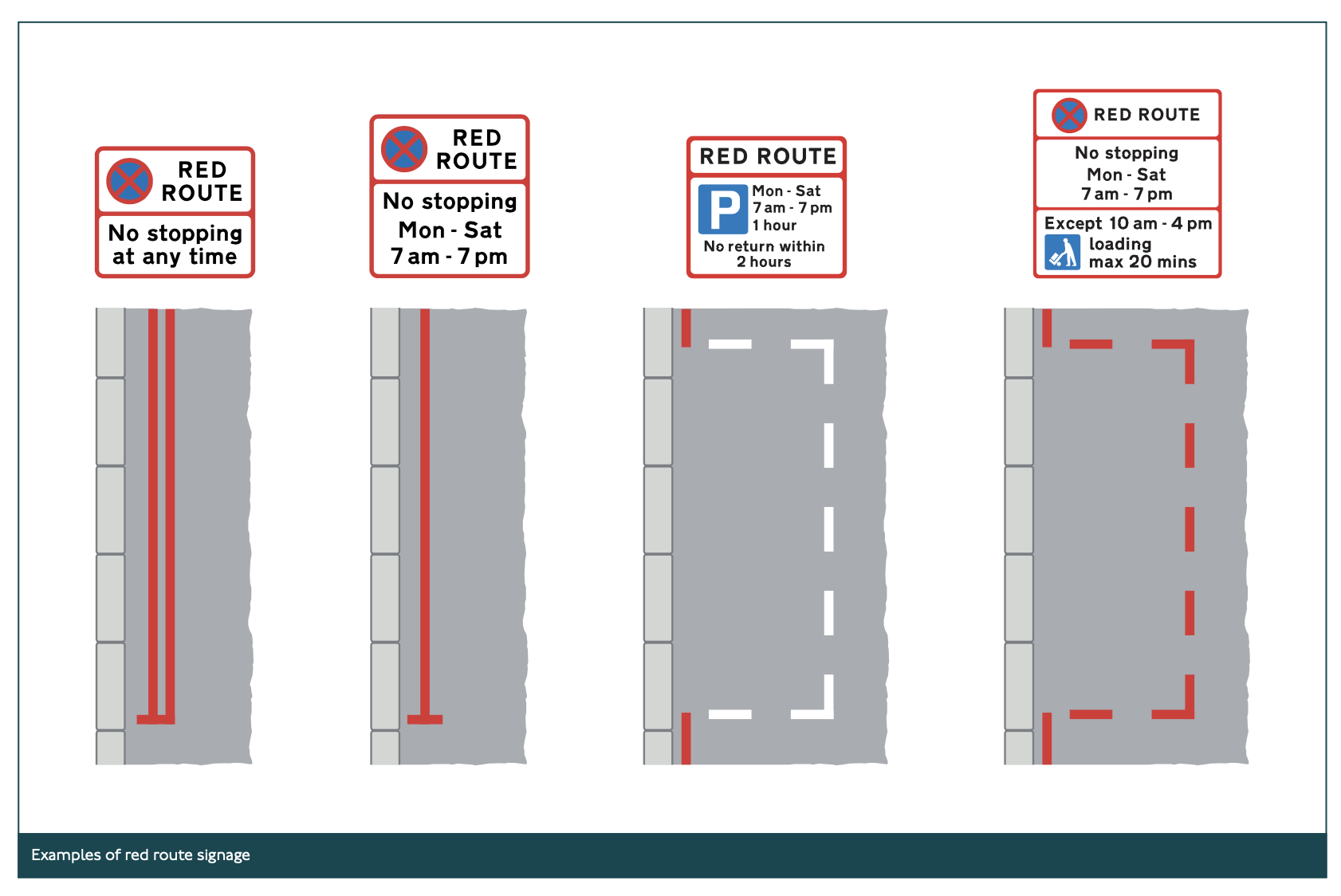
Red routes are the main roads in London and are marked with red lines by the kerb and, where required, with signs.
A single red line means the restrictions apply part of the time. Typically, red route restrictions operate from 07:00 to 19:00 each day. If there are double red lines, the controls apply all day.
You can pick up or drop off passengers on single or double red lines, but you must not wait for a passenger where restrictions apply, even if you have arrived early for a booking, or the passenger is late or wants to visit somewhere (such as a certain shop).
The only exception is that we allow taxis to stop on the red route to wait for passengers to use a cashpoint, but only between the hours of 22:00 and 06:00 and for no longer than five minutes.
You must never, for any reason, stop within pedestrian clear ways, zig-zag lines, bus stops with wide red lines, or any place where your taxi would cause an obstruction or danger to other road users.
There are some sections of road with particularly busy bus stops or other problems where the exemptions for taxis do not apply. You cannot stop in these places. These bus stops are marked with a wide red line by the kerb, in place of the normal single or double red lines.
Some parts of red routes are marked for parking. Parking bays can be identified by a sign marked with a P, along with details of when and for how long parking is allowed, and how soon a vehicle can stop again in the same section of road.
You can pick up or drop off passengers and you can park or wait in a parking bay as long as you obey the time limits and restrictions shown on the sign.
In some locations, there are special bays marked for pick up or set down. These have a maximum time limit of two minutes and are only to be used for picking up or set ting down passengers.
Some taxi ranks are marked on red routes. A s with other ranks, these are for taxis plying for hire. Taxis should not be left unattended on these ranks.
Bus lanes
There are many bus lanes in London and licensed taxis can use most of them. However, there are a few exceptions and you should read the signs so that you know which ones you can use and when.
Penalty Charge Notices (PCNs)
PCNs can be given out by on-street parking attendants or enforcement officers, or sent to the registered keep er of the vehicle if the vehicle was caught on camera breaking the law. You may get a PCN even if you do not see an enforcement officer, and the PCN does not have to be attached to the windscreen of your vehicle to be valid.
You can get a PCN for parking offences or other moving traffic offences, such as driving in a bus lane, banned turns or movements (such as an illegal U-turn) or blocking a yellow box junction.
There is often a discount for early payment of a p enalty charge. If you contact the council within the discount period to say that you are challenging the PCN, the time limit for this discount is increased. If you are not the registered keep er of your taxi, you should arrange for the keeper to pass on any PCNs as soon as possible so that you can pay or write to the council to challenge the charge within the time limit.
What do I do if I get a PCN which I believe is unjustified?
All traffic authorities recognise that mistakes can sometimes be made, and have arrangements in place in case a driver challenges a PCN.
TfL and some councils publish information online about how to challenge a PCN, and details will be provided on the PCN. When making a challenge, it will help if you can provide any extra evidence, such as details of the passenger, a record of the journey, or photographs of the location if you believe the signage is incorrect. If you are a member of one of the trade associations or unions, they may be able to advise you on how to challenge a PCN.
If your challenge is not accepted, you have the right to appeal to London Tribunals. You will not have to pay to appeal and you can go to hear your case at the tribunal if you want to. Again, providing copies of all appropriate evidence will help your case. London Tribunals’ decision is final, and both the driver and the authority have to accept it. The tribunal can decide that one side should pay the other side’s costs if either side has acted unreasonably.
Congestion Charge and Ultra Low Emissions Zone
All London licensed taxis are exempt from the Congestion Charge and Ultra Low Emissions Zone (ULEZ ) charges. If you receive a PCN that you think is an error, you should first follow the instruction on the PCN. You should only contact TfL after you have requested an appeal, and this request has been accepted.