

You will not be tested on this information.

You may be tested on this information.
Section 1: Doing your job
In this section we set out the basic information you need to know to do your job as a London taxi driver

Some of it covers things you must do, such as wearing your badge while working. Although the rest of the information is not compulsory, we still think it is important that you know it.
What to take with you
When you are working, you must have your taxi driver‘s badge, licence and identifiers with you.
Only experience will tell you what else you need every day, but we suggest that you always have the following items with you when working:
- An appropriate cash float
- Pen and notebook
- Air freshener
- Brush for cleaning out your taxi
- Sick bags
- Single-use gloves
- Spare light bulbs (if your taxi needs these) and fuses
- Receipt books/pads and printer receipt rolls, in order to give customers receipts
Mobile phone cradle or a hands-free device for your mobile phone – this is essential as it is illegal to use a handheld mobile phone or electronic device when driving

Taxi driver‘s badge, licence and identifiers
Whenever you are plying for hire or carrying a passenger you must wear your taxi driver‘s badge so it is clearly visible and carry your copy of your taxi driver‘s licence. Do not hang your badge on the rear-view mirror or keep it in your pocket.
If you own your taxi, you should keep your original taxi driver‘s licence in a safe place at home. If you hire your taxi, the owner must hold your original licence.
If a passenger asks for your badge number, you should show them your badge so they can write down the number.
You sometimes need to show your badge and licence to enter a restricted area. If you can’t show these items and have a passenger on board, it will be your passenger who is inconvenienced if you are denied access.
You must wear your taxi driver’s badge if you attend court in your role as a licensed taxi driver. You should also consider taking your paper taxi driver’s licence to court to prove, if necessary, that you are currently licensed.
Your personalised identifiers should always be displayed while you are working and removed from your taxi when you are not working. They should show your badge number and, for suburban taxi drivers, details of the area for which you are licensed. The identifiers should be displayed in the top nearside (kerbside) corner of both the front and rear windows.
Please remember that your identifiers are not proof that you are licensed. If you are asked to prove that you are licensed – for example, by a police officer, TfL compliance officer or taxi proprietor – you must show your licence and your badge.
Your appearance
We encourage licensed taxi drivers in London to lo ok clean and smart when working. You should dress in a way that shows you are a professional self-employed businessperson in a service industry.
Your taxi
Always keep your taxi clean. Keep items such as brushes, bulbs and tools in the boot of your taxi and do not leave these in the driver or passenger compartment.
Make sure the luggage area in the front of your taxi is clear and has space for passengers’ bags, etc.
Make sure the current taxi fare chart is fixed in the passenger compartment, and any other signs or stickers are in good condition.
If you plan to take part in one of the taxi sharing schemes, you should carry the approved taxi sharing card to display in the taxi.
Plying for hire
You can ply for hire by driving along the streets or by waiting on a taxi rank. Strictly speaking, you can only be hired when your vehicle is stationary. So, when you are travelling along a street with your‚ ‘taxi’ light on, you are available for hire, but you do not have to stop when hailed by a member of the public.
However, the public expect that a taxi with its light on will stop if they hail it. If you don’t stop, the person may make a complaint, and you also miss an opportunity to earn money. There is also a risk that the person may think you did not stop owing to possible discrimination because of who they are.
If you are not available for hire, ensure your‚ ‘taxi’ light is turned off to avoid any misunderstandings. Once you stop when hailed, whether or not your ‘taxi’ light is on, you must accept the fare unless there are legal reasons for not doing so.
If your taxi is stationary because of traffic conditions or at traffic lights, you don’t have to accept a hiring unless you have made it clear to the person that you are willing to be hired.
Do not approach possible customers to ask them if they want a taxi. This could be interpreted as touting, which is illegal.
You cannot ply for hire, pick up or set down passengers on motorways.
If you are a Suburban (yellow badge) taxi driver, you must not ply for hire outside of the suburban sectors you are licensed for.
Taxi fares and the taximeter
An up-to-date taxi fare chart should be clearly displayed in the passenger compartment of your taxi.
You must start the taximeter no sooner than when the taxi is hired, or at such later time as you think fit. You must stop the taximeter no later than when the hiring is terminated or at such earlier time as you think fit.
See also ‘Starting and stopping the taximeter’ in section 3 of this handbook about disabled passengers.
The taximeter calculates the maximum fare based on the time of day, distance travelled, and time taken. It is illegal to charge more than the metered fare.
Extras
The extras you can charge are listed on the fare chart – make sure you know the details of these. You cannot charge extra for carrying luggage, additional passengers, wheelchair users or assistance dogs, or for accepting card payments. The extra charges are set by TfL and the value is the maximum that can be charged. However, you can choose to charge less or make no extra charge.
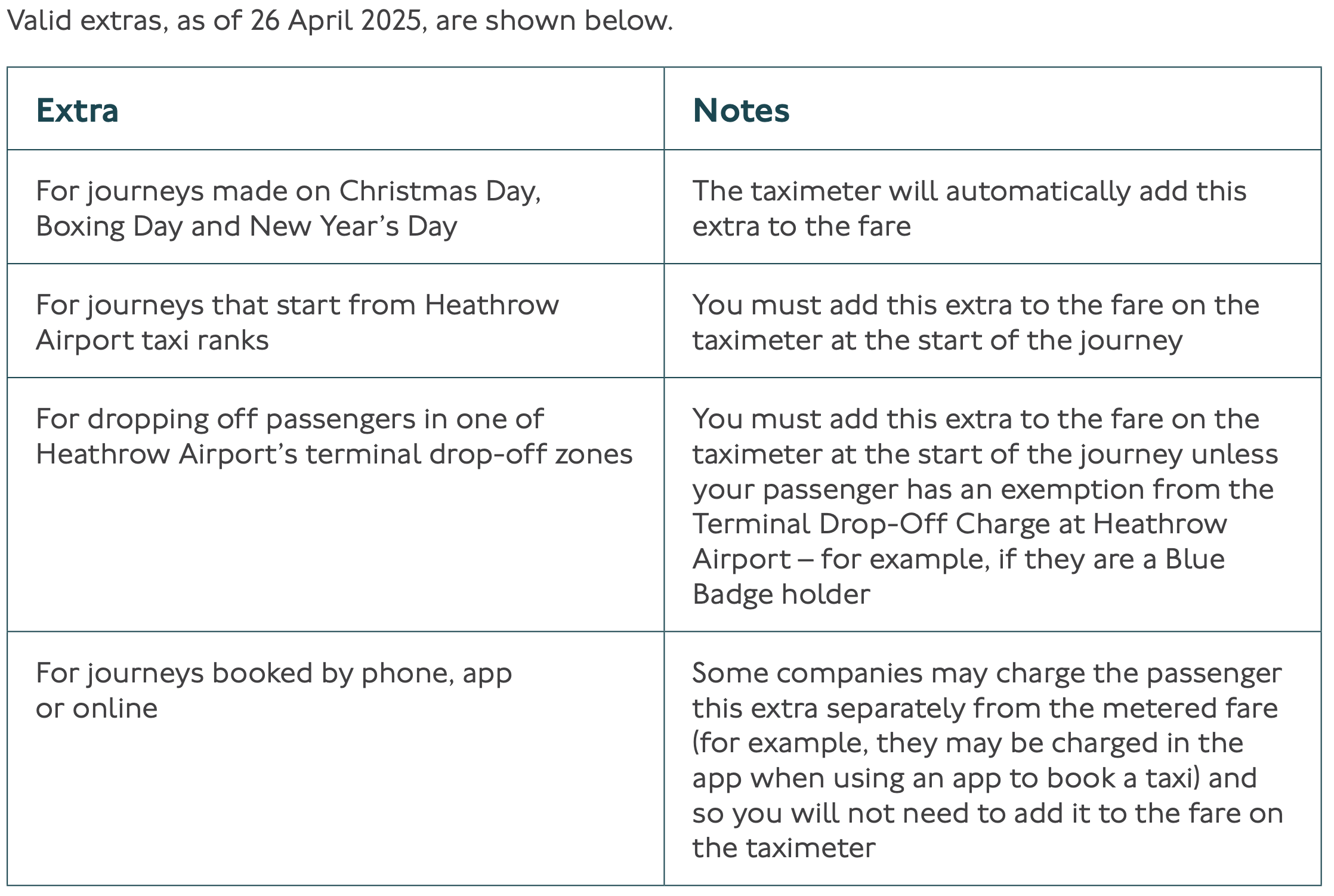
Also shown on the fare chart is a soiling charge (in case passengers damage the taxi or make it dirty, for example because of sickness or other accidents). You can charge this extra if the taxi has to be taken out of service for cleaning. However, this is not a metered extra, so if the passenger fails to pay, you will have to use the small claims court to try to get your money. Visit our website for more information about taxi fares and tariffs.
Refusals
One of the most common complaints by taxi passengers is drivers refusing to take them to where they wanted to go. In most cases you are obliged to accept a fare if the journey is not more than 12 miles (12 miles, or 20 miles from Heathrow Airport, is the maximum distance a taxi driver may be compelled to drive).
The only reasons you can refuse a fare are:
- The journey is more than 12 miles, or more than 20 miles if it starts at Heathrow Airport
- The journey is likely to last for more than one hour
- The journey ends outside the Greater London area
You are not compelled to accept a hiring for luggage and/or animals unaccompanied by a passenger, or to carry items or animals likely to cause damage to the taxi or its fittings. However, you must take guide dogs and other assistance dogs. And we encourage you to be as helpful as possible.
If you do refuse a hiring for one of the above reasons, be polite and explain why. This could help to avoid a complaint.
The law does allow you to refuse a journey if you have, a ‘reasonable excuse’, such as passengers who are drunk, aggressive or verbally abusive. You can also refuse to take passengers who have luggage that is likely to damage the taxi, or passengers who have anything else that might soil the taxi.
If you believe you have a justifiable reason to refuse a fare, make a note of the situation as soon as possible. Again, this may be helpful if there is a complaint. It’s also important to think about what might happen to the passenger if you refuse to take them. For example, they could be at risk of harm or abuse if you leave them where they are.
Journeys outside Greater London
You do not have to accept any fare to destinations outside Greater London. If you do accept such a hiring, you should either agree the fare with the passenger in advance or, if no fare is agreed, take the hiring on the taximeter. If you agreed the fare in advance, you must not charge more than the agreed fare at the end of the journey. You must still start the taximeter at the beginning of every journey.
If the fare starts and ends in Greater London but the route goes out of the capital, the taximeter must be used for the whole journey, and you cannot charge more than the metered fare.
Fixed-fare shared-taxi scheme
Fixed-fare shared-taxi schemes operate at a number of locations and events. Passengers share their taxi with other people they may not know, and each passenger pays a fixed fare. Formal regulations for these schemes were introduced in 2005.
Key points of the schemes are:
- If you choose to take part in a fixed-fare shared-taxi scheme, you must show this by displaying an official sign in your taxi
- If a passenger asks for an exclusive (not shared) journey or a journey to a destination not covered by the fixed-fare scheme, normal rules on compellable distance and refusals apply, even if you would prefer to take a shared journey
- The taximeter should not be started until all of the passengers are in the taxi – time waiting for passengers to share must not be charged
For fixed-fare shared-taxi schemes:
- Passengers will board the taxi at an authorised starting point, which is normally a taxi rank
- Marshals are usually present to organise sharing
- Destinations are also defined, along with the fixed fares to these destinations
The fixed-fare shared-taxi conversion table can be used to calculate fares for shared journeys to other destinations. When using the fixed-fare shared-taxi conversion table the fare payable is based on the number of passengers sharing the taxi at the start of the journey. If you do not have the conversion table, you cannot charge more than the metered fare.
If you take part in a fixed-fare taxi-sharing scheme you should display the official, ‘Fixed-Fare Shared-Taxi’ sign. These signs are available from TfL.
Heathrow Airport
In addition to taxi laws, Heathrow Airport has its own byelaws which are very strictly enforced. The byelaws are outlined in the Abstract of Laws. Only licensed All London taxi drivers are allowed to ply for hire and use the taxi ranks at Heathrow Airport.
To ply for hire at Heathrow Airport you must first go through the Heathrow Airport taxi feeder park, which controls access to the ranks at the terminals. You should make sure you know how the system works before you use the feeder park for the first time. Some taxi trade associations and Knowledge schools will arrange visits to Heathrow to learn how the system works. Heathrow Airport Ltd charges a fee for using the feeder park.
When you leave the feeder park you will be sent to one of the terminals, where the rank agents will give a fare to you. You must not start the taximeter until the taxi is hired.
Many fares from Heathrow are to local destinations, so you should take the time and trouble to learn the location of hotels and other places passengers may want to go to. To make short local fares more attractive to taxi drivers, Heathrow Airport Ltd operates a system where you do not need to go through the feeder park and pay the fee again. You will receive a ticket if you are given a short journey which will allow you to return directly to the terminal rank within one hour of accepting the first fare.
As Heathrow Airport is close to the edge of Greater London, many taxi journeys are to destinations outside of Greater London. You should therefore be aware of the rules regarding fares for journeys that end outside the Greater London area.
In the interests of offering a reliable service, we encourage you to accept local journeys that go outside London. To help you quote fares, the taxi trade associations at the Airport publish suggested prices to destinations outside London – please note that these fares are only a guide and they are not set or approved by TfL. But remember, if you fail to agree a fare with the passenger in advance, you must charge the metered fare.
You should also make yourself aware of the ‘Fares Fair’ scheme which offers passengers fixed fares to certain locations that are just outside London.
Heathrow Airport Ltd charges a fee for dropping off passengers in one of the terminal drop-off areas. You can add an extra charge to the fare to cover this fee when dropping off passengers in these drop-off areas. Passengers who do not want to pay the extra charge can be dropped off in the Park and Ride car parks (previously known as the long-stay car parks) for free and take the free bus to the terminals.
Heathrow Airport Ltd charges the fee each time a taxi enters a terminal drop-off zone. If several passengers want to be dropped off at different terminals in one journey, the extra can be added to the fare each time the taxi enters a different terminal drop-off zone. If your passengers want to go to different terminals, please ask them if they prefer to:
- Pay the drop-off extra for each separate terminal they are using
- All be dropped off at the same terminal and only pay the drop-off extra once
Not pay the extra at all and instead be dropped off in a terminal Park and Ride/ long stay car park and take the free bus to the terminals Blue Badge holders can apply to Heathrow Airport Ltd for a full discount from the terminal drop- off charge. If a Blue Badge holder has this discount, the extra charge must not be added to the fare. Visit our taxi fares web page for information about Blue Badge discounts.
Lost property
It is worth asking your passengers to make sure they have not left anything behind when they leave your taxi. You should also check your taxi yourself for lost property after every hiring.
You must take any Property you find to any Metropolitan Police station or City of London Police station as soon as possible after wards and definitely within 24 hours. All lost property is then sent to TfL’s Lost Property Office, which will try to return it to its owner.
Lost property can also be taken directly to the Lost Property Office at:
TfL Lost Property Office
Stephenson Street
London
E16 4SA
When property is returned to the owner, they are charged a percentage of the value of the property by the Lost Property Office, which is then passed to the driver as a reward.
Lost property which is not claimed within three months of the last day of the month in which it reached the Lost Property Office may be returned to the driver.
Items that contain personal data such as laptops, digital cameras and mobile phones cannot be returned to drivers. However, if the item is in good condition, an award is paid to the driver.
Valuable Property is kept for a longer period in order to give the owner the chance to claim it.
Suspicious items and behaviour
Items left in your taxi are likely to be items passengers have left behind by accident, but if you think an item is suspicious, call the police immediately on 999 and follow their instructions.
If you think an unattended bag, package or other item in your taxi is suspicious:
- Do not ignore it
- Do not touch it
- Do attempt to find out who owns it
If this is unsuccessful, you should switch off your engine and evacuate the immediate area. Call the police, but do not use a radio or mobile phone within 25 metres of the item. Remain in the area to identify yourself and the item to the police.
Be aware of what is going on around you and of anything that seems different or unusual or doesn’t feel right, or anyone who you think is acting suspiciously. You can report any suspicious activity to the confidential police anti-terrorist hotline on 0800 789 321.
Don’t worry about wasting police time or getting someone into trouble. The police will decide if the information is important and will treat it as private and confidential.
Private hire bookings
As a licensed taxi driver you can accept a journey that has been pre-booked through a licensed London private hire operator. Even though it is a private hire journey you must still start your taximeter at the beginning of the journey. If the journey is to start and finish within London, the fare charged must either be the pre-quoted private hire fare or the metered fare, whichever is the lower.
Etiquette
It is generally accepted that taxi drivers allow other taxi drivers to exit from side roads on to a main road. If another driver allows you to pull out in front of them and you both have your ‘for hire’ light on, signal or allow that taxi to overtake you at the earliest opportunity. This then allows that taxi driver the opportunity to take the first hiring. If it is not practicable to allow the other taxi to overtake and you are hailed, make it clear to the prospective passenger that the taxi behind you is the one to be hired.
‘Stealing’ another driver‘s fare or sending the passenger to the next taxi in the rank just because you do not want to take the fare (known as ‘brooming’) are common grievances among taxi drivers. Every taxi driver is working for a share of the same market, and the next good fare will not be far away.
Finance
As a self-employed person, you will need to make a tax return at the end of every financial year. Most taxi drivers require the assistance of an accountant. Many accountants who specialise in dealing with taxi drivers advertise in the trade papers, and some will offer a free first consultation (appointment). Alternatively, if you join one of the trade organisations, they may be able to recommend accountants.
You should keep all the receipts for expenses that relate to your work (the first receipt is the one for paying for your new licence) and attach them to the weekly record book your accountant will provide.
Is this for all Taxi drivers, including Suburban?
Hi Terry, yes it’s for both London and Suburban.