

You will not be tested on this information.

You may be tested on this information.
Section 6: Safer driving
This section tells you how to maintain the highest standards of driving
Obey the law
As a taxi driver, you are expected to be fully aware of and to Obey the rules of the road, as explained in The Highway Code. You should avoid behaviour that causes any danger to you, your passengers and other road users.
Most collisions in London are caused by a small number of easy-to-avoid behaviours. These include speeding or driving too fast for the conditions, making dangerous manoeuvres, not concentrating and not following the rules of the road.
You need to be aware of your responsibilities as a professional driver. Think about:
Safe speeds
Drive within the speed limit at a speed that is appropriate for the situation, environment and weather conditions.
The faster you drive, the less time you have to act to avoid a collision. The resulting injuries also become more serious as speed of the vehicle increases.
Safe manoeuvres
Think about the manoeuvres you make, and make sure they are safe. This includes looking carefully when at a junction, when turning across traffic or when passing cyclists or motorcyclists.
Careless driving and dangerous driving are serious offences with heavy penalties.
Concentration
You need to focus on the road and be able to react quickly. Don’t get distracted (lose your concentration) because of mobile phones and other electronic devices, music or passengers.
Distractions can make you less aware of what is happening on the road and affect your judgement so your decision-making abilities are reduced.
Remember it is illegal to use hand-held devices while driving. See ‘Use of a mobile phone’ below for more information.
Use of alcohol or drugs
You must never drive while you are under the influence of drugs or alcohol.
The police test for drug and alcohol use at the roadside to catch those who are breaking the law.
Prescription medicine If you are taking prescription medicine, you must check with your doc tor that it is safe for you to drive.
You must also tell the DVLA if:
- You develop a ‘notifiable’ medical condition or disability
- A condition or disability has got worse since you got your licence
Following traffic laws before a journey begins
You need to know about and follow the laws on the safe use of vehicles. This includes laws that require you to have insurance, a current MOT certificate and a driving licence, wear a seat belt and not drive a faulty vehicle (a vehicle that isn’t working properly).
Seat belts
Wearing a seat belt can reduce the risk of death in a serious crash by up to 50 per cent. This is according to Brake, the road safety charity.
It is important that you are aware of the rules regarding passengers wearing seat belts in taxis.
You do not have to wear your seat belt when you are carrying a paying passenger or plying for hire but remember seat belts save lives and help to reduce injuries. You must wear your seat belt if you are delivering a letter or parcel or if your taxi light is off and you do not have a passenger on board (for example, when you are going home or driving on a motor way with no passenger on board).
All adults must wear a seat belt and you should encourage adult passengers to wear a seat belt for their own safety. When you accept a hiring, allow passengers time to fasten their seat belts before starting the journey.
Drivers must make sure all children are correctly seated and have a seat belt on if they are required to do so. All children under 14 years of age must wear a seat belt or sit in an approved child car seat.
If the correct child car seat is not available, children can travel without one – but only if they travel on a rear seat and wear an adult seat belt if they are aged three or older, or without a seat belt if they are under three years old.
The police closely watch London’s roads 24 hours a day and will identify drivers who break the law. If you fail to obey any of the above rules, you may get a fixed penalty notice (FPN) or be prosecuted – this can result in a fine and penalty points on your licence. You may be banned from driving and you could lose your taxi driver‘s licence.
Remember, the number of passengers must not be more than the number of seat belts fit ted in the passenger compartment.
Being aware of other road users
We expect all professional drivers to be fully aware of other road users. In particular those people who are the most vulnerable:
Pedestrians: Be aware of pedestrians suddenly stepping into the road and give way to pedestrians crossing or waiting to cross a road into which or from which you are turning.
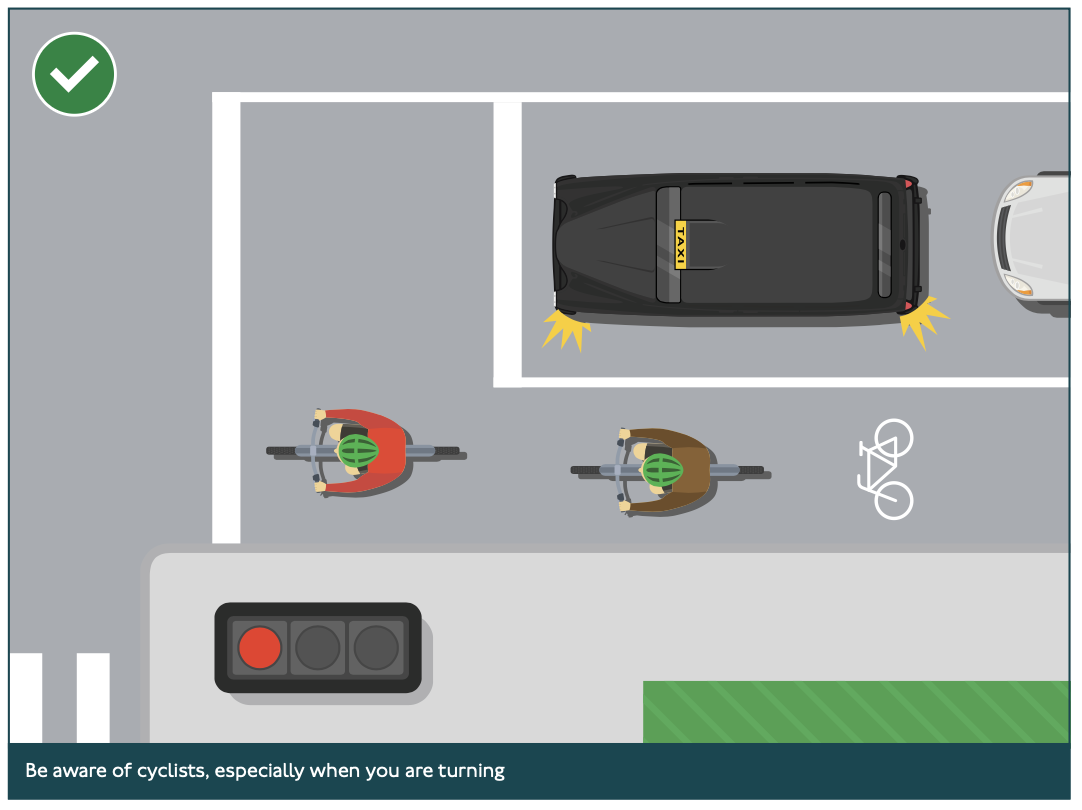
Cyclists: Be aware of cyclists at all times but especially when you are turning, in slow moving traffic or when you are pulling away from traffic lights. Make sure you give cyclists enough room when you are over taking them.
Please ask your passengers to check before they open their door into the road to make sure there isn’t a cyclist coming. You must do the same.
Motorcyclists: Be aware of motorcyclists at all times but especially when you are turning or in slow moving traffic.
E-scooters: Be aware of e-scooter riders at all times but especially when opening doors, turning or in slow moving traffic.
Windscreen vision
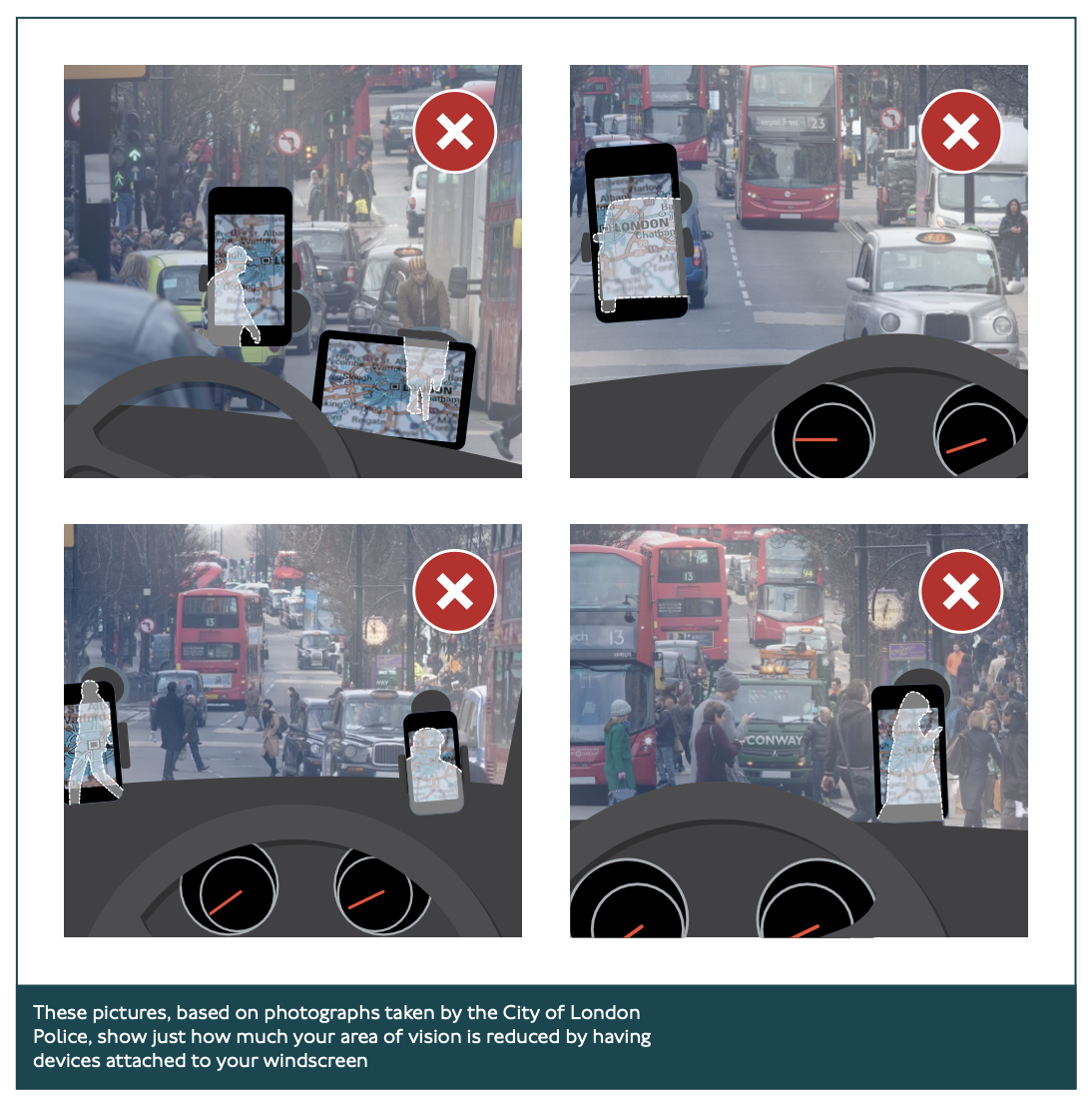
Annex 6 of the Highway Code, which deals with vehicle maintenance, says ‘windscreens and windows must be kept clean and free from obstructions to vision’.
That means you should not fix anything to your windscreen that will stop you being able to see the road ahead. This includes mobile phones, satnavs and other devices that will reduce your vision.
If you put a cradled device (such as a mobile phone or sat nav) on your windscreen and it blocks your view of the road and the traffic ahead, you are committing an offence. If you are prosecuted, you may be fined and get penalty points on your driving licence.
These pictures, based on photographs taken by the City of London Police, show just how much your area of vision is reduced by having devices attached to your windscreen
Before starting any journey, make sure you have a clear view through the windscreen and windows of your taxi and that no devices or signage reduce or are obstructing your view.
If you fix a device to your windscreen, make sure it:
- Does not affect the operating controls in your taxi
- Does not obstruct your view of the road
- Is not placed in front of/above any airbag
- Is not positioned where it can affect your concentration if it should fall down from the windscreen
Driving conditions can change quickly. If your view is obstructed by devices attached to your windscreen, you risk not paying attention or not seeing dangers such as pedestrians stepping in front of you or bikes coming out of side streets in time to avoid them.
Use of a mobile phone
It is illegal to use a handheld mobile phone or electronic device when driving. This includes using your device to follow a map, read a text or check social media. This includes times when you are stopped at traffic lights or queuing in traffic.
You can only use a handheld phone if you are safely parked with the engine switched off or you need to call 999 or 112 in an emergency, and it‘s unsafe or not practical to stop.
Using hands-free (where the phone is in a cradle or you are using earphones or a Bluetooth connection) is not illegal. However, if this affects your concentration and your ability to drive safely, you can still be prosecuted by the police.
It is illegal to use handheld microphones or to hold your mobile phone and put it on loudspeaker when driving.
Other things to consider
Being tired: Tiredness can have a similar effect on a driver as drinking alcohol and can result in death or serious injury. Plan your day to include regular breaks from driving and do not begin a journey if you are already tired.
Weather conditions: You should change your driving behaviour when the weather conditions change, so that you are always driving safely. If it starts to rain heavily or there is thick fog, reduce your speed.
Driving at night: You should pay particular attention when driving at night because pedestrians, cyclists and motorcyclists may be more difficult to see.
Cycle safety
Taxi drivers spend a lot of time on the roads and it is very important that you follow the advice below so you can reduce the risk of a collision:
- Always check for cyclists, pedestrians and motorcyclists who may be moving, even if most vehicles are stopped in traffic
- Look out for cyclists, especially when checking your mirrors before indicating to go left or right, or when changing your speed or direction
- Open your door slowly, do not throw it open without looking first
- When you or your passengers get out of your taxi use the Dutch Reach. This is where you open the door with the hand furthest away from the door, instead of using your closest hand. Doing this enables you to lo ok in the rearview mirror, out to the side and then over your shoulder to see if there is a cyclist coming towards you. It also means that you keep looking back wards while you open the door and get out.
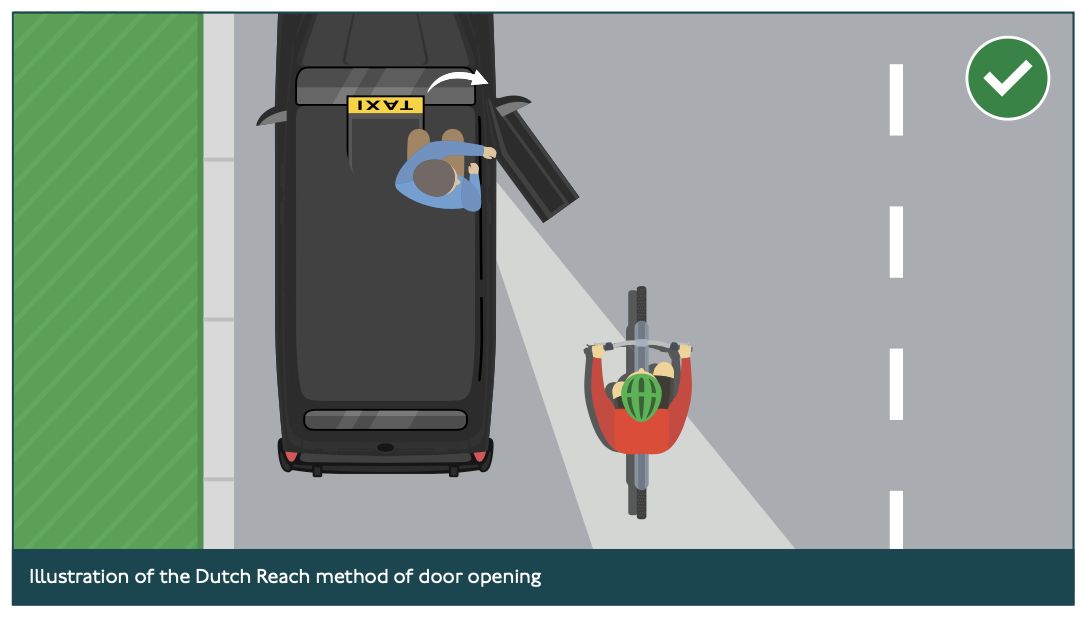
- Ask your passengers to leave your taxi on the nearside in order to reduce the risk of opening the door into the path of an oncoming cyclist
- Use your indicators when turning or changing lanes, even if you don’t think anyone is near you
- Indicate well in advance to give others time to react
- Make sure your indicator is off once you have completed your manoeuvre, to avoid confusing other road users
- Give cyclists room. Keep a safe distance from cyclists and don’t try to overtake when there is not enough space. Wait for the right moment to pass cyclists and give as much space as you would for another car. If a cyclist is using the middle of the lane, wait patiently until you can pass safely
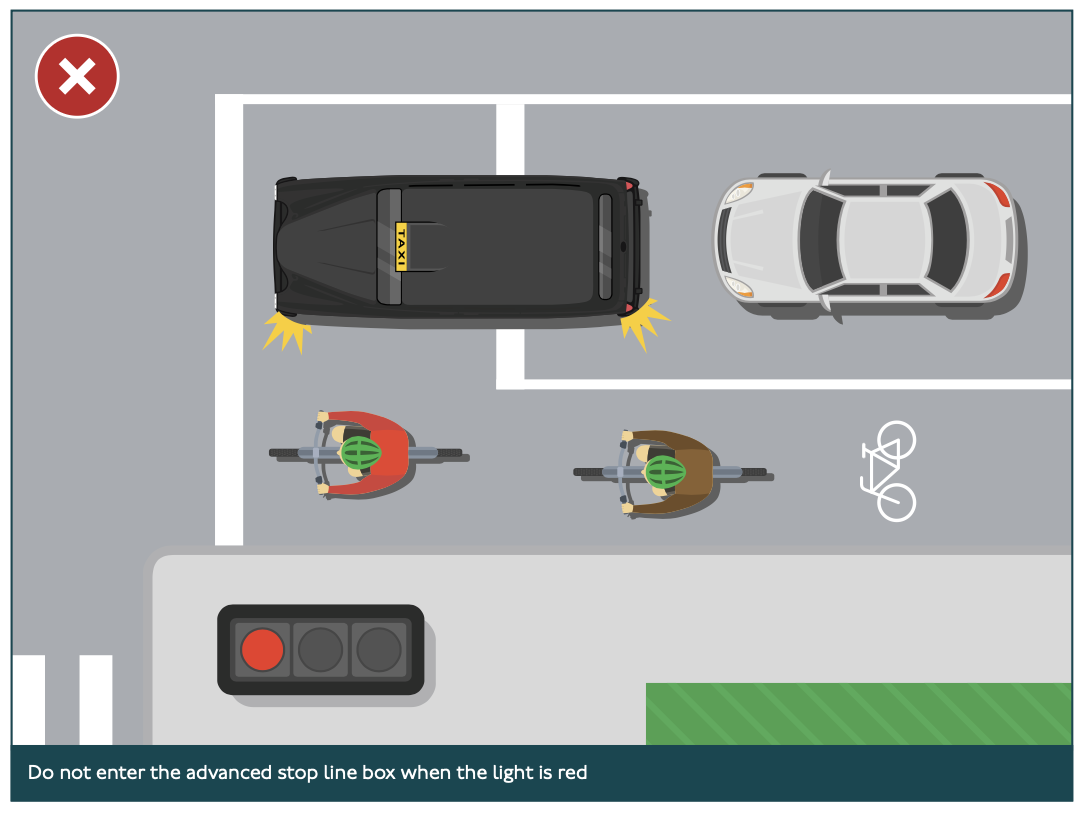
- Leave room for cyclists at traffic lights. You should not enter the advanced stop line box when the light is red. This space is for cyclists and you may be fined and get points on your driving licence
The above advice and tips also apply to those riding e-scooters.
Vehicle safety
As a professional driver you are responsible for checking your taxi is in a safe and legal condition to drive.
Driver‘s compartment
Check that:
- Your seat and seat belt are in good condition, are secure and you can adjust (move) them as you need
- The steering wheel is secure and is in good condition
- The clutch and brake pedals have anti-slip covers fit ted
- The handbrake is in good working order
- Driver warning lights do not light up when the engine is started
- The indicators are working correctly
- The horn works
- The windscreen washers and wipers are in good condition
- Any devices for opening and closing the driver and front passenger windows are working correctly
- You can see in all the mirrors
Passenger compartment
This should be clean and all equipment in it must be in good working order including:
- Seat belts fit ted to all passenger seats
- Upholstery (material covering the seats), headlining (material covering the inside of the roof), carpets and door trims (material surrounding the doors)
- Lights provided for passengers
- Wheelchair safety belts/seat belts
- All doors and door-locking mechanisms
- Vehicle heater system
You must also make sure the following signage is displayed:
- TfL no-smoking signs
- CCTV signage, if applicable – see ‘CCTV cameras’ in section 5 for more detail
Wheels and tyres
Tyres must be the correct size, speed and weight rating for the make and model of your vehicle. You should make sure all wheel nuts (that attach the wheels to the vehicle) are in place and secure.
Tyres must be free from:
- Cuts, lumps, bulges and tears
- Excessive or unequal tyre wear
- Excessive damage to the wheel rim (the outside edge of the wheel)
Tyre wear bar indicators are positioned around the tyre. If the tread pat tern has worn down to the level of the indicators, you must replace the tyre.
Outside the vehicle
Make sure there are no signs of fluids (such as oil or brake fluid) leaking from under your taxi on to the ground.
You should check:
- All external (outside) lights and reflectors are there and are secure, undamaged and in good working order
- Body panels (the sheets/pieces of metal or other material around a vehicle) have not been badly repaired
- There is no evidence of serious damage to the external body panels
- There is no serious rusting or corrosion resulting in sharp edges
- All windows are clean, undamaged and free from unapproved signs