

You will not be tested on this information.

You may be tested on this information.
Section 3: Being aware of equality and disability
This section gives you advice on assisting disabled passengers and others requiring help

Assisting passengers
Taxis are a very important part of the accessible transport network, and it is important that disabled people can hire a taxi without having to pay any extra cost. We expect taxi drivers to provide excellent customer service to all passengers, whatever their needs. However, we know that some passengers may need more help.
Here is some advice to help you provide the best service to your passengers.
- If you see a disabled person hailing your taxi, don’t just drive past them
- Make sure you know how your wheelchair ramps work, how to safely load a wheelchair into the taxi, and how to make it fully secure in the correct position by using the wheelchair restraints (safety locks/belts) and passenger belts
- Make sure that the wheelchair ramps are available and in good working order at all times – if they are not, your taxi is unfit
- Make yourself aware of all the other features in your taxi that help disabled people (for example swivel seat, intermediate step, hearing loop), and let your passengers know about them
- Always ask your passengers if they need any help and wait for your offer to be accepted. Listen to any requests and remember that everyone is different
- Ask passengers what you can do to make their journey more comfortable
- Be ready to give disabled and older passengers some help. This could be as simple as writing things down for them, giving them a little extra time, facing them so they can see your lips as you speak, or speaking loudly and clearly if they have problems hearing you
- Talk directly to an older or disabled person, rather than to the person with them if they are travelling with someone
- If the passenger is vision-impaired (is blind or has other sight problems) and asks you to guide them to the vehicle, stand by the person’s side and allow them to take hold of your arm/elbow so that you can guide the passenger along. Do not take hold of the passenger and pull or push them in a particular direction
- Disabled or older passengers may need more time or help to get in and out of your taxi. For their safety, be patient and make sure they are comfortable and have their seat belt on and fastened before you start the journey
- Ensure your luggage compartment is kept free so that there is space for passengers’ mobility aids (for example folded wheelchairs, folded walkers, etc)
- You can also help by asking the passengers if they have all their possessions with them before you set off and when you arrive at their destination
- Tell the passenger where they are going and let them know about any possible dangers, such as pavement kerbs, doors opening towards or away from them and ground that isn’t flat. This will help prevent accidents and injuries
- During the journey, vision-impaired passengers in particular should be told about any delays, or changes to the route. This is also a good thing to do with elderly passengers or passengers who have a learning disability, as they might get worried or upset if there is a change to the route they expected to take
- When you arrive at your destination, tell the passenger the location, then offer to help them out of the taxi and guide them to a safe place before leaving them
- Clearly tell the passenger how much the fare is. When you give change to passengers who are vision-impaired, it is important to count out the coins and notes into their hand
- Offer to help count out the change if a passenger looks like they are having difficulty with this
- Always have a pen and paper with you so that you can write things down. This can help passengers who have a problem hearing or passengers who don’t speak much English
- Don’t start the taximeter until a wheelchair passenger is safely in your taxi and their mobility aids have been securely stored. You must stop the taximeter as soon as you arrive at the passenger‘s destination and before the passenger has got out of your taxi with their mobility aids
- Taxi drivers can stop to pick up or drop off passengers, including disabled passengers, in many places where there are rules which limit waiting or stopping. Section 9 of this handbook includes information on where taxis can stop
- Be careful where you pick up and drop off wheelchair users. Avoid places where the pavement is not flat
Non-visible disabilities
Don’t assume that a person doesn’t have a disability or that their disability isn’t serious, just because you can’t see it.
Not all disabilities can be seen, so offer or be prepared to help any passenger.
Make sure you listen to what the passenger asks you to do for them.
Equality Act
The following characteristics are protected under the Equality Act:
- Age
- Disability
- Gender reassignment
- Marriage and civil partnership
- Race
- Religion or belief
- Sex
- Sexual orientation
- Pregnancy and maternity (the time after having a baby)
It is illegal to treat anyone unfairly based on any of the things listed above. It is unacceptable for you as a taxi driver, or for any of your passengers, to use language or behave in a way that discriminates against any person. As a taxi driveryou are expected to treat all passengers in a professional and respectful way without making a judgement about any person’s personal characteristics or assuming anything about them.
The Equality Act 2010 places duties (responsibilities) on the drivers of taxis.
The Taxis and Private Hire Vehicles (Disabled Persons) Act 2022 amended the Equality Act 2010.
Before the changes, the Equality Act required drivers of designated wheelchair accessible vehicles to accept fares from wheelchair users, provide them with reasonable mobility assistance and not charge them more than other passengers.
The changes made by the 2022 Act mean that all taxi drivers have duties under the Equality Act, even if their vehicle is not a designated wheelchair accessible vehicle.
Providing mobility assistance
Section 164A of the Equality Act states that all taxi drivers who are aware that a passenger is disabled and may require mobility assistance must carry any disabled person and provide mobility assistance without making, or proposing to make, any additional charge.
You have a legal duty to:
- Carry the passenger
- To carry their wheelchair (if reasonable and safe to do so)
- To carry their mobility aids (if reasonable and safe to do so)
- Not make, or propose to make, any additional charge for carrying out the duties listed above
- To take reasonable steps to carry the passenger in safety and in comfort
- Give the passenger mobility assistance as is reasonably required
The Equality Act defines the mobility assistance reasonably required for the passenger as:
- To enable the passenger to get into or out of the vehicle
- To load the passenger‘s luggage, wheelchair or mobility aids into or out of the vehicle
The duty does not mean that a driver is required to carry more than one wheelchair on any journey, or carry a passenger who it would normally be lawful to refuse.
Pre-booked taxis
Section 165A of the Equality Act places duties on any driver of a pre-booked taxi to:
- Assist any disabled person to identify and find the vehicle, as long as the driver is told that the passenger will require such help
- Not make, or propose to make, any additional charge for complying with this duty
Wheelchair users
Section 165 of the Equality Act places additional duties on drivers of designated wheelchair accessible taxis. All London taxis are designated as wheelchair accessible and so you must:
- Carry a passenger seated in a wheelchair
- If the passenger chooses to sit in a passenger seat, carry the wheelchair
- Carry the passenger‘s mobility aids
- Not make, or propose to make, any additional charge for carrying out the duties listed above
- Take reasonable steps to carry the passenger in safety and in comfort
- Give the passenger mobility assistance as is reasonably required
The Equality Act defines the mobility assistance reasonably required for the passenger as:
- To enable the passenger to get into or out of the vehicle
- If the passenger wishes to remain in the wheelchair, to enable the passenger to get into and out of the vehicle while in the wheelchair
- If the passenger does not wish to remain in the wheelchair, to load the wheelchair into or out of the vehicle
- To load the passenger‘s luggage into or out of the vehicle
The only reasons for exemption are medical. If you have a medical or physical condition that makes it impossible or unreasonably difficult for you to comply with these duties, you can apply for an exemption certificate from TfL. If you are given an exemption you will receive a certificate that you must carry at all times and a sign that must be displayed wheneveryou are plying for hire.
There are many different types of wheelchairs/powerchairs and it is recommended, if possible, to become familiar with loading and unloading the more common types that you may have to deal with.
If you are hired by someone using a wheelchair that is unfamiliar to you, always ask the person the best way to Act (including how best to assist them with loading), as it is likely that they will be familiar with their own wheelchair and able to direct you as necessary. You should also consider the weight and size of the wheelchair and if it can be secured safely in the passenger compartment. A wheelchair should always be carried in the approved position for the taxi you are driving and secured when travelling (straps/ belts attached to wheelchair, with the seat belt around the occupant).
We are often asked what would happen if a driver is injured while helping a wheelchair user. To ensure this doesn’t happen, you should find out in advance how to load and unload a wheelchair and always follow the correct safety steps. Your insurance policy may cover this kind of situation, and you may wish to contact your insurance company about this issue.
Mobility scooters
You may come across passengers who use a mobility scooter. Mobility scooters are mobility aids, and there are lots of different mobility scooters.
London taxis are designed to carry wheelchairs that match the description set out in section 4 of the Department for Transport ‘s Access to taxis and private hire vehicles for disabled users. Mobility scooters are not wheelchairs and are not safety tested in the same way, nor are they designed for transporting anyone as a passenger in another vehicle.
If a mobility scooter user wishes to hire your taxi, you will need to assess whether they can travel safely in your taxi with their mobility scooter. You should consider:
- The size and weight of the scooter
- Can the passenger transfer from their mobility scooter to one of the standard seats in your taxi?
- Can the mobility scooter be secured safely in the passenger compartment?
- Can the Mobility scooter be folded and stored safely in the luggage compartment?
If you consider that it is not safe for the person to travel in your taxi with their mobility scooter, you should politely explain the reasons why to them.
If the passenger is able to sit in the standard taxi passenger seats, and you are able to safely secure their mobility scooter or store it safely in the luggage compartment, it may be safe to carry it. Carrying the scooter in these ways is important to avoid injuring the passenger or yourself, or causing damage to their scooter or your taxi.
Assistance dogs
Your legal duties are to:
- Carry a disabled person’s assistance dog and allow it to remain with the passenger at all times
- Not charge any more for carrying an assistance dog
You can only be exempted from these duties on medical grounds, such as severe asthma that is made worse by contact with dogs, or if you are allergic or have an acute phobia of dogs. To obtain an exemption, you must apply to TfL using the appropriate form. If you are given an exemption, you will receive a certificate that you must carry at all times and a sign that must be displayed whenever you are plying for hire.
Some passengers may have a health condition that is not obvious or visible (including mental health conditions and some other medical conditions) but will still have an assistance dog. If someone says they are disabled and they have an assistance dog, you should accept this.
Watch our short video about what taxi drivers should do when a passenger has an assistance dog.
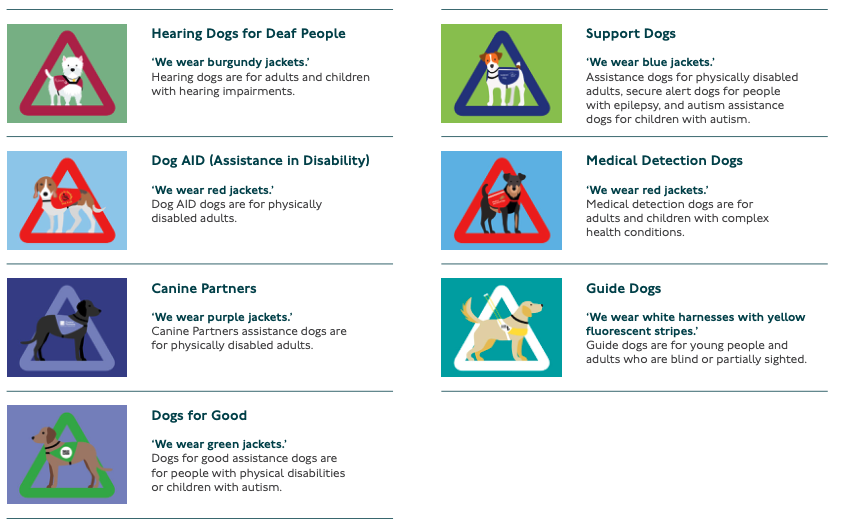
Assistance dogs are highly trained working animals so should not be treated like pets. Do not touch or feed assistance dogs or try to get their attention in any other way. If you would like to greet a working dog, you should ask its owner for permission and comply with their wishes about whether it is appropriate to do so.
There are many different types of assistance dogs. You can sometimes see what type of assistance a dog provides by the colour of the jacket it is wearing.
The pictures on above show some of the assistance dogs you might come across. Please remember that assistance dogs are not always the same breed (family) as shown in the pictures, and not all assistance dogs wear a jacket.
Dogs and Islamic law
In 2002, the Shariah Council confirmed that trained assistance dogs may accompany disabled people in taxis managed or driven by Muslims. The Council’s guidance helps to make religious law clear and prevent any possible conflict with non-religious law.
Starting and stopping the taximeter
Remember you must:
- Not start the taximeter until a disabled passenger is in your taxi, their mobility aids have been securely stored, and they are ready to travel
- Not leave the taximeter running while you perform any of the duties required by the Equality Act (including using the ramps, helping the passenger enter the vehicle, loading mobility aids), or while the passenger enters, leaves or secures their wheelchair in the passenger compartment of the taxi
- Stop the taximeter as soon as you reach a disabled passenger‘s destination and before the passenger has got out of your taxi with their mobility aids
If you start the taximeter early or leave it running, this could result in your fitness to be licensed being reviewed.